

In May 2026 an electric car became the best-selling vehicle in Australia. Not the best-selling EV. The best-selling vehicle.

The Tesla Model Y outsold the Ford Ranger and the Toyota HiLux in May, then did it again in June with a record 8,072 units. For a country whose new car market has been defined by utes for two decades, that is a genuine hinge point.
Battery electric cars took 21.7% of the market in July 2026, more than triple the 7.2% of a year earlier. Chinese brands took 58% of the EV market in the first half. In February, China became Australia’s largest source of vehicles for the first time since 1998. Ten EVs now sell for under $37,000 drive-away. Here are the eight worth your money.
The Shortlist at a Glance
| Car | From | WLTP range | Best for |
|---|---|---|---|
| BYD Atto 1 | $23,990 | 220 km | Cheapest new EV in Australia |
| MG4 EV Urban | $31,990 d/a | 316 km | Longest warranty on any new car |
| Geely EX5 | $41,990 | 475 km | Most car for the money |
| BYD Sealion 7 | $55,020 d/a | 482 km | Equipment per dollar |
| Tesla Model Y | $58,900 | 466 km | The default choice |
| KGM Musso EV | $60,000 d/a | 420 km | The only real electric ute |
| Zeekr 7X | $63,900 | 615 km | Road trips |
| Kia EV9 | ~$101,760 d/a | 512 km | Seven seats and towing |
1. Tesla Model Y — The Car That Beat the Ranger
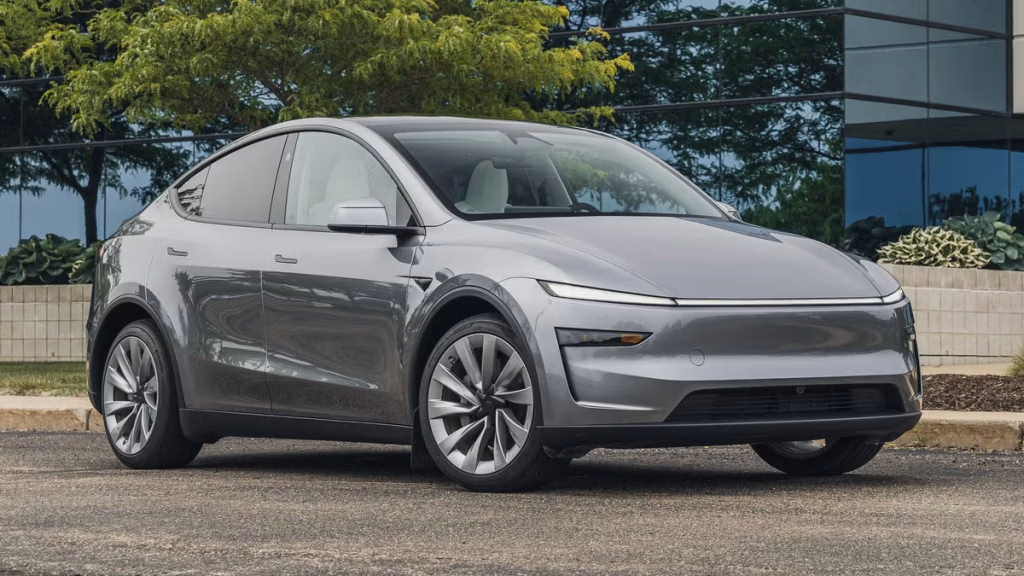
20,396 sold in the first half of 2026, roughly a fifth of every EV delivered in the country. The Model Y is the default recommendation because it is the only one where the car, the charging network, the resale value and the software all resolve into a single low-friction story. Nothing else here has a Supercharger network behind it.
It also tows 1,588 kg braked, which quietly beats most of the Chinese competition. Worth knowing: Tesla’s share of the Australian EV market has slipped to about 22% against BYD’s 28%, and the cheaper Model Y Standard that America gets is not coming here any time soon.
Price: $58,900 before on-roads, about $63,963 drive-away
WLTP range: 466 km
Towing: 1,588 kg braked
ANCAP: 5 stars (2025), and ANCAP’s medium SUV category winner
2. Geely EX5 — The Most Car for the Least Money
Geely sold precisely zero cars in Australia at the start of 2026 and 8,790 EX5s by the end of July. That is the fastest new-brand ramp this market has seen, and it happened because the EX5 is a mid-size family SUV with 475 km of range for small-hatch money.
For 2026 Geely fitted a larger 68.39 kWh battery, worth an extra 45 km, and charged $1,000 for it. It has 11 kW AC charging, 3.3 kW vehicle-to-load and a heat pump. Check the price basis carefully when you enquire, because Geely quotes $41,990 before on-road costs while dealer listings in Sydney land closer to $46,300 drive-away.
Price: $41,990 before on-roads (about $46,300 drive-away in Sydney)
WLTP range: 475 km
Battery: 68.39 kWh LFP
Fast charging: 100 kW, 30 to 80% in 20 minutes

3. BYD Atto 1 — Cheaper Than a Petrol Mazda2
$23,990 before on-roads makes the Atto 1 the cheapest new electric car in Australia, and cheaper than several petrol light cars it sits alongside. It still gets vehicle-to-load and a five-star Euro NCAP rating with 82% adult occupant protection.
The honest limitation is 220 km of WLTP range on the Essential, which in real Australian conditions means a city car and a second car, not a only car. The Premium at $27,990 gets a 43.2 kWh pack and 310 km, and is the version most people should buy.
Price: $23,990 before on-roads (Essential); $27,990 (Premium)
WLTP range: 220 km / 310 km
Fast charging: 65 kW / 85 kW
Worth knowing: Vehicle-to-load standard

4. MG4 EV Urban — Ten Years of Warranty
$31,990 drive-away, and the longest warranty on any new car sold in Australia: ten years or 250,000 km, conditional on dealer servicing. For a buyer whose real anxiety about a cheap Chinese EV is who fixes it in year eight, that is the whole argument.
The 43 kWh version does 316 km and the 54 kWh Essence does 405 km for $34,990 drive-away. It launched in April 2026 straight into a fuel price spike, which did it no harm at all. Note it has not been ANCAP tested yet, and published DC charging figures for the car vary considerably, so check the spec sheet on the exact car you are quoted.
Price: $31,990 drive-away (43 kWh); $34,990 (54 kWh Essence)
WLTP range: 316 km / 405 km
Warranty: 10 years / 250,000 km with dealer servicing
ANCAP: Not yet rated

5. Zeekr 7X — The Road Trip Car
615 km of WLTP range and 800-volt architecture that peaks at 420 kW. The base rear-drive car actually charges faster still at 450 kW, the highest rate of anything sold in Australia. It also has a 22 kW onboard AC charger, which matters more here than the headline DC number, because a great deal of regional Australian charging infrastructure is AC only.
Zeekr went from launch to 7,950 Australian sales in seven months. If you regularly drive Sydney to Melbourne or Brisbane to the Sunshine Coast and back, this is the car on the list where the charging stop stops dominating the day.
Price: $63,900 before on-roads (Long Range RWD); $57,900 (RWD)
WLTP range: 615 km
Battery: 100 kWh NMC
Fast charging: 420 kW on 800V, plus 22 kW AC

6. BYD Sealion 7 — The Equipment Play
12,516 sold in the first half of 2026, second only to the Model Y. The Sealion 7 feels like a $90,000 car at $55,000: rotating 15.6-inch screen, Dynaudio system, ventilated seats, 482 km of range and 150 kW charging.
One hard caveat, and it is the reason this is not higher on the list. The Premium rear-drive version tows just 750 kg braked, less than a small petrol hatchback. If you own a boat, a box trailer or a camper, this car is disqualified regardless of how good the interior is. The Performance AWD manages 1,500 kg.
Price: $55,020 drive-away (Premium RWD); $68,874 (Performance AWD)
WLTP range: 482 km / 456 km
Fast charging: 150 kW
Towing: 750 kg braked (Premium) / 1,500 kg (Performance)

7. KGM Musso EV — The Only Real Electric Ute
First, the correction this section exists for: the BYD Shark 6 is a plug-in hybrid, not an electric vehicle. It burns petrol. A lot of Australians have this wrong, and it matters when you are comparing running costs.
The Musso EV, on sale since December 2025, is Australia’s first all-wheel-drive battery-electric ute and the only affordable one you can actually order. 80.6 kWh, up to 300 kW charging, 905 kg payload on the 2WD and vehicle-to-load for tools on site. Towing is 1,800 kg braked, which is half a Ranger. That makes it a tradie and light-trailer ute, not a tow-the-van ute, and anyone telling you otherwise is selling something.
Price: $60,000 drive-away (2WD); $64,000 (AWD)
WLTP range: 420 km (2WD) / 380 km (AWD)
Towing: 1,800 kg braked
Payload: 905 kg (2WD) / 805 kg (AWD)
8. Kia EV9 — Seven Seats and 2,500 kg of Towing

The EV9 is the only EV in Australia that puts three genuinely usable rows, 2,500 kg of braked towing, 3.6 kW vehicle-to-load and a seven-year unlimited-kilometre warranty in one vehicle. It is also expensive, and that is part of the story: proper seven-seat electric motoring has not come down in price the way everything else on this list has.
On towing, be realistic. Owners report 35 to 40 kWh per 100 km hauling a two-tonne van, which turns a 500 km car into roughly 220 km between charges. That is not a fault of the EV9, it is aerodynamics, and it applies to every electric tow vehicle. Plan the trip around it and the EV9 works. Assume the brochure range and it will ruin your holiday.
Price: From about $101,760 drive-away (Air)
WLTP range: 443 to 512 km depending on trim
Towing: 2,500 kg braked, the highest of any mainstream EV here
Warranty: 7 years unlimited km
Above $100,000: What the Money Actually Buys
Everything above is chosen on value and volume, which is where Australia actually buys. Above about $150,000 the numbers collapse: Porsche sold 58 Taycans in the first seven months of 2026, Volvo moved 142 EX90s, Lotus managed three Eletres. The high end here is a rounding error on the sales chart.
It is still where the interesting engineering lands first, and there is one genuine exception to the low-volume rule. Three worth knowing about.
BMW iX3 50 xDrive — the longest range on sale in Australia
805 km WLTP. Nothing else sold here comes within 150 km of it, and the 400 kW charging means a 21-minute stop from 10 to 80%. It is also the first car ever to win World Car of the Year and World Electric Vehicle of the Year in the same year.
The Australian angle is the price. At $109,900 it undercuts the Audi SQ6 at $156,400, the Polestar 5 at $171,100 and the Porsche Macan GTS at $171,100 by up to $30,000, while out-ranging all three. There is also a strategically important detail for anyone on a novated lease: BMW added an iX3 40 at $89,900, deliberately positioned under the $91,661 luxury car tax threshold, which means it stays FBT-exempt while the 50 xDrive does not.
Price: $109,900 before on-roads (iX3 40 from $89,900)
WLTP range: 805 km
Battery: 108 kWh
Fast charging: 400 kW, 10 to 80% in 21 minutes
FBT exempt: No on the 50 xDrive, yes on the iX3 40
Porsche Macan GTS — the one that drives properly
The job no cheaper Australian EV can do is steer. The Macan is the reference for how an electric SUV should handle, and the GTS is the value pick within the range: it sits just 10 kW below the Turbo while costing $16,500 less, and it was a finalist for the 2026 CarExpert Choice Best Luxury EV award.
584 km of range and 800-volt charging that gets to 80% in 21 minutes means it is not a weekend toy either. If your budget is here and you actually enjoy driving, nothing else on this page is close.
Price: $171,100 before on-roads (range from $129,800; Turbo $187,600)
WLTP range: 584 km
Battery: 100 kWh
Fast charging: 270 kW, 800V
Polestar 5 — the long-distance GT, engineered in Coventry
670 km WLTP makes this the longest-range luxury GT on sale in Australia, and it is a low, wide grand tourer rather than another tall SUV, which is a body style that simply does not exist below $100,000 here.
The interesting part is underneath. The Polestar 5 is the first car on Polestar Performance Architecture, a bonded aluminium unibody engineered in-house by the company’s British team in Coventry, and about 83% of its aluminium is smelted using renewable electricity. A Chinese-owned brand doing its flagship engineering in the English Midlands is not what most people expect.
Price: $171,100 before on-roads (Performance $193,100)
WLTP range: 670 km
Battery: 106 kWh usable
Fast charging: 350 kW, 800V
Also at this level: the Mercedes-Benz GLC 400 4MATIC with EQ Technology at $112,200 is the freshest thing in the market, orderable as of August 2026 with 630 km and 330 kW charging. The Volvo EX90 won 2026 CarExpert Choice Best Luxury EV and is the seven-seat answer. And the halo is the Porsche Cayenne Turbo Electric at $259,900, which makes 850 kW with overboost, reaches 100 km/h in 2.5 seconds and is the most powerful production Porsche ever built. It also tows 3,500 kg, which no other EV here gets close to.
One tax note that governs this entire segment. The fuel-efficient luxury car tax threshold for 2026-27 is $91,661, and every car in this section sits above it, so all of them attract LCT at 33% of the excess and none of them qualify for the FBT exemption. That threshold is now visibly shaping how cars are priced here: Cadillac cut the Lyriq by $32,000 in May to duck under it, and Genesis cut the GV60 by $14,700 in July for the same reason. If a novated lease is part of your plan, the $91,661 line matters more than any spec on the page.
A Note on Australian Incentives in 2026
The era of state cash rebates is over. Every one of them has closed: New South Wales in January 2024, Queensland in September 2024, South Australia at the end of 2023, Western Australia in May 2025. What remains at state level is minor. Victoria still gives $100 back at registration renewal, Queensland keeps registration and duty discounts for vehicles under $100,000, the ACT offers stamp duty exemption for zero-emission vehicles plus interest-free loans up to $15,000, and the Northern Territory has the most generous package left with a $1,500 stamp duty concession and discounted registration through to 30 June 2027.
The real incentive in Australia is the FBT exemption on novated leases, and it is worth far more than any rebate ever was. Eligible electric cars that have never been subject to Luxury Car Tax are exempt from fringe benefits tax, and so are running costs including electricity, at the ATO’s 5.47 c/km home charging rate. This is why the Cadillac Lyriq was permanently cut by $32,000 in May 2026, from about $122,000 to $90,000 before on-roads, purely to duck under the fuel-efficient LCT threshold. For 2026-27 that threshold is $91,661.
That exemption is now on a legislated wind-down. It runs unchanged to 31 March 2027. From 1 April 2027 a $75,000 cap applies, with a 25% discount between that and the LCT threshold. From 1 April 2029 the full exemption ends and becomes a permanent 25% discount. If a novated lease is part of your plan, the next eighteen months are the best window there will be.
Behind all of this sits the New Vehicle Efficiency Standard. The first results landed in February 2026 covering the second half of 2025, and they were brutal for some: Mazda ran a deficit of 508,517 units, Nissan 215,261, Subaru 139,635. Roughly two-thirds of manufacturers met their target. The largest credit holders are BYD, Toyota and Tesla, and those credits are quietly funding the price aggression you see at the cheap end of this list.
On charging, Australia had more than 1,500 fast charging sites by June 2026, up from 55 in 2018. The Hume and Pacific corridors are effectively solved. The problems that remain are specific and worth planning around: the 625 km gap between Katherine and Tennant Creek on the Stuart Highway is the longest in the country, about 68% of Western Australian public chargers and 62% of South Australian ones are AC only and no use for touring, and holiday peaks are brutal. On Good Friday 2026 the Coolac site on the Hume ran at maximum occupancy for eight straight hours with queues reported up to five hours, at a site that is busy less than 1% of the year.
Prices and specifications are current as of August 2026 and move quickly in this market, particularly at the cheap end. We update this page rather than replacing it, and every update is dated. Compare any of these against the global field in our EV Range Chart, or see how the market looks in the UK and France.
Electric Future covers the global electric vehicle transition: the technology, the market shifts, and the cars worth caring about.