

Britain quietly became one of the best places in the world to buy an electric car.
Not because of the weather, and not because of the charging network, though that passed 120,000 public chargers in April. It happened because the UK decided not to put tariffs on Chinese electric cars when the EU and the US did. The result is a price war that European buyers can only watch from a distance. There are now two new EVs on sale in Britain for under £13,000, and according to Autotrader data the government cited in April, electric cars are on average cheaper to buy than petrol equivalents for the first time.
Battery cars took a record 27.5% of new registrations in July 2026. Here are the eight that actually make sense, whether you are doing the school run in Sheffield, commuting into the ULEZ, or covering 25,000 miles a year up and down the M6.
The Shortlist at a Glance
| Car | From | WLTP range | Best for |
|---|---|---|---|
| Dacia Spring | £11,990 | 140 miles | Cheapest new car in Britain |
| BYD Dolphin Surf | £18,675 | 200 miles | Cheap without feeling cheap |
| Renault 5 E-Tech | £21,495 | 250 miles | The one you actually want |
| Vauxhall Frontera Electric | ~£24,000 | 253 miles | Family SUV on a budget |
| Nissan Leaf | £28,499 | 386 miles | Range per pound, built in Sunderland |
| Kia EV3 | £34,555 | 376 miles | Best all-rounder |
| Tesla Model Y | £41,990 | 314 miles | The safe answer |
| Mercedes CLA 250+ | £45,615 | 484 miles | Longest range here |

1. Dacia Spring — The Cheapest New Car in Britain
£11,990. That is the whole pitch, and it is a very good one. Dacia cut the Spring below twelve grand on 1 July 2026, and on the same day Leapmotor cut the T03 to £12,995, which tells you everything about how hard the bottom of this market is being fought.
Here is the detail almost nobody reports correctly: that £3,750 discount is Dacia’s own money, not the government’s. The Spring is built in China, so it does not qualify for the Electric Car Grant at all. Dacia simply matched the top grant band out of its own margin. You get 140 miles, a 24.3 kWh battery and very little else, and for a second car that never leaves a 30-mile radius, that is enough.
Price: £11,990 OTR
WLTP range: 140 miles
Battery: 24.3 kWh LFP
Electric Car Grant: Not eligible. The discount is Dacia’s own

2. BYD Dolphin Surf — Cheap Without Feeling Cheap
The Dolphin Surf is where the price war stops being about stripping things out and starts being about actual engineering. The Boost version does 200 miles on a 43.2 kWh pack, charges at 85 kW, and includes vehicle-to-load so you can run a kettle or a laptop off the car. Carwow measured around 4.4 miles per kWh in city driving, which is genuinely excellent.
BYD backs it with a six-year, 93,750-mile warranty. It has not been Euro NCAP tested yet, which is the one thing worth waiting on if safety ratings drive your decision. Otherwise this is the point on the price ladder where an electric car stops being a compromise.
Price: From £18,675 OTR (Active); Boost from around £21,000
WLTP range: 137 miles (30 kWh) / 200 miles (43.2 kWh Boost)
Fast charging: 65 kW / 85 kW
Worth knowing: Vehicle-to-load included; no Euro NCAP rating yet

3. Renault 5 E-Tech — The One You Actually Want
Britain’s best-selling electric car in July 2026, on 1,805 registrations, and the only car on this list people talk about with actual affection. It won European Car of the Year in 2025 and then took New Car of the Year and New EV of the Year at the 2026 AM Awards, which is a lot of silverware for a small hatchback.
The trick is that Renault channelled the original’s personality without making a costume. It is properly good to drive, the interior is warm rather than clinical, and the 52 kWh version does a real 250 miles. It qualifies for the Electric Car Grant, though check carefully which battery you are getting at the headline price, because the entry car is the smaller 40 kWh urban pack.
Price: From £21,495 OTR including grant; 52 kWh Techno+ from £23,945
WLTP range: 194 miles (40 kWh) / up to 258 miles (52 kWh)
Fast charging: 100 kW
Electric Car Grant: Yes, Band 1 on the Comfort Range

4. Vauxhall Frontera Electric — The Unglamorous Bestseller
Fifth best-selling EV in Britain in July, on 1,248 units, and almost nobody writes about it. The Frontera is proof that a large number of buyers want a plain, roomy, cheap family SUV and do not care about the rest. The Extended Range version does 253 miles on a 54 kWh pack and charges at 100 kW.
If you want the same car with a longer warranty and slightly sharper styling, the Jaecoo E5 does the same job from £27,505 and was the third best-selling EV in July. Jaecoo went from nothing to 34,067 UK registrations in the first half of 2026, which is the single clearest illustration of what no tariffs on Chinese cars has done to this market.
Price: From around £24,000 OTR depending on grant band
WLTP range: 193 miles (44 kWh) / 253 miles (54 kWh Extended Range)
Fast charging: Up to 100 kW
Alternative: Jaecoo E5 from £27,505, seven-year warranty
5. Nissan Leaf — The British-Built Range Champion

386 miles for £28,499 is the best range-per-pound on this list by a wide margin, and it is the only car here built in Britain. Production started at Sunderland in December 2025, and that is precisely why it earns the full £3,750 Electric Car Grant while cars from further afield are capped at £1,500 or excluded entirely.
The third-generation car has nothing in common with the Leaf that burned early adopters. The air-cooled battery is gone, replaced by proper liquid cooling. The CHAdeMO plug that stranded a generation of owners is gone too. It charges at 150 kW. Nissan followed it in April by unveiling an electric Juke, also for Sunderland.
Price: £32,249 list, £28,499 after the full grant
WLTP range: 386 miles (75 kWh) / 271 miles (52 kWh)
Fast charging: 150 kW
Electric Car Grant: Yes, full £3,750 Band 1. Built in Sunderland
6. Kia EV3 — The Best All-Rounder

2025 World Car of the Year, and second in the UK EV chart in July on 1,691 registrations. The EV3 is the car the cheaper entries on this list are measured against: 376 miles from a 78 kWh usable pack, a genuinely well-resolved interior, and the sense that every decision was made by someone who had thought about it.
It is a 400-volt car, so it charges at 135 kW rather than the 250 kW-plus of the 800-volt brigade. In practice that means a slightly longer motorway stop in exchange for a car that costs considerably less. Skoda’s Elroq does much the same job if you prefer a bigger boot.
Price: From £31,555 including grant; Long Range £34,555
WLTP range: 376 miles (Long Range)
Battery: 78 kWh usable
Fast charging: 135 kW
7. Tesla Model Y — The Safe Answer
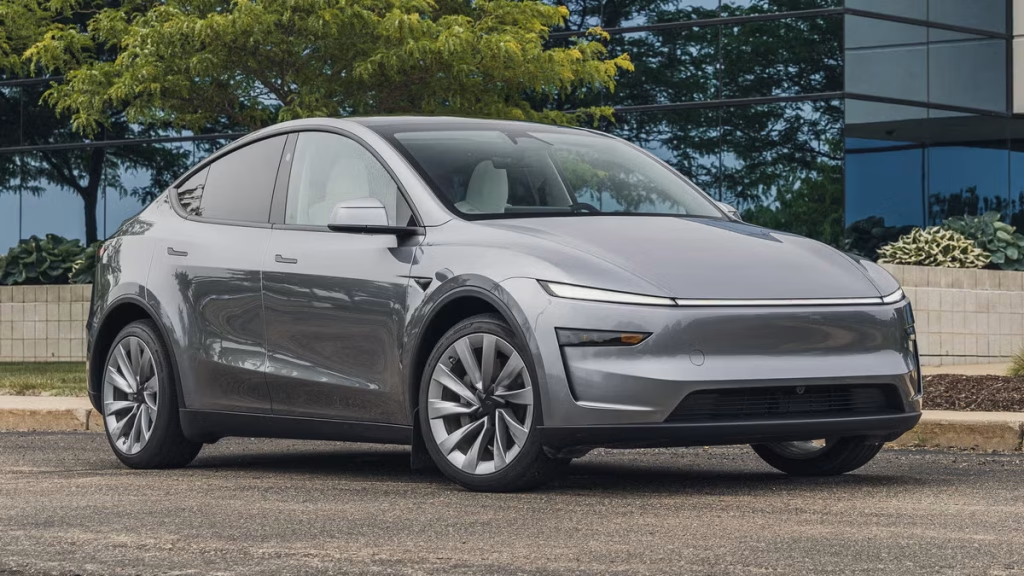
Britain’s best-selling EV in 2025 on 24,298 registrations, with the Model 3 second on 21,188. You are buying the Supercharger network as much as the car, and it remains the most frictionless fast-charging experience in the country.
The Standard arrived in December 2025 as a £3,000 price cut achieved by deleting the panoramic roof, the rear screen and the front light bar. If you want the range, the Long Range rear-wheel drive at £44,990 does 383 miles and is the sweet spot of the lineup. Both now sit under the new £50,000 luxury surcharge threshold, which quietly saved Model Y buyers £440 a year for five years.
Price: £41,990 (Standard) / £44,990 (Long Range RWD)
WLTP range: 314 miles / 383 miles
Fast charging: 175 kW / 250 kW
Luxury surcharge: No, both sit under the £50,000 threshold
8. Mercedes CLA 250+ — 484 Miles, and the Efficiency Argument

484 miles WLTP, from a car that costs less than a mid-spec BMW iX3. The CLA gets there through obsessive efficiency rather than a giant battery: a 0.21 drag coefficient, one of the slipperiest shapes in production, wrapped around an 85 kWh pack. It also has a 101-litre frunk on top of a 405-litre boot.
It was tenth in the July UK EV chart despite the price, which for a £45,000 car in a list dominated by £25,000 ones is telling. If you regularly drive long distances and want to stop thinking about charging entirely, this is the car on this list that gets you closest.
Price: £45,615 (Sport Edition)
WLTP range: Up to 484 miles
Battery: 85 kWh usable
Luxury surcharge: No on Sport Edition, yes on AMG Line trims above £50,000
Above £50,000: What the Money Actually Buys
Everything above is chosen on value, and that reflects where Britain actually buys. In the July 2026 EV top ten, only two premium nameplates charted at all, the Audi Q6 e-tron in ninth and the Mercedes CLA in tenth, and nothing above roughly £70,000 appeared anywhere. The high end here is a small, high-margin business.
It is also where the engineering happens first. If your budget stretches past the £50,000 Expensive Car Supplement threshold, three cars are worth the jump.
BMW iX3 50 xDrive — the one that swept the awards
The iX3 is the first car ever to take World Car of the Year and World Electric Vehicle of the Year in the same year, and it added What Car? Car of the Year on top. It is not a critical darling that nobody buys either: order books opened in September 2025 and were approaching 100,000 by July 2026.
What the money buys is the removal of the compromise that defines every cheaper car on this list. 500 miles of official range and 400 kW charging means roughly 230 miles added in ten minutes. Be realistic about the range, though: independent testing has returned 3.0 to 3.5 miles per kWh against an official 3.68, so think 380 to 420 real miles rather than 500. That is still more than anything else here.
Price: £58,755 OTR (M Sport £60,755); entry iX3 40 from £53,250
WLTP range: Up to 500 miles
Battery: 108.7 kWh usable
Fast charging: 400 kW, 10 to 80% in about 20 minutes
Porsche Macan 4S Electric — the one that is actually fun
Nothing under £50,000 is enjoyable to drive in the way this is. The Macan 4S makes 516 PS and 820 Nm, hits 62 mph in 4.1 seconds, and with the optional rear-axle steering Porsche claims 40% greater stability than the combustion Macan. It is the consensus pick for the best-driving electric SUV at any price.
The unusual part is that it is also properly useful. It tows 2,500 kg on an electrically deployable towbar, which no cheap EV on this list comes close to, and 800-volt architecture gets it from 10 to 80% in about 21 minutes.
Price: £78,300 (range from about £69,865; Turbo £99,300)
WLTP range: 326 to 379 miles
Battery: 100 kWh
Towing: 2,500 kg braked
Porsche Cayenne Electric — the newest thing at the top
First UK deliveries began in June 2026, and it resets the ceiling. 400 kW charging takes a 108 kWh pack from 10 to 80% in 16 minutes, which is faster than most cars here manage from a 50 kWh pack. Porsche has also confirmed inductive wireless charging as an option about a year after launch, a first at this end of the market.
Then there is the Turbo, which makes 1,156 PS and is the most powerful production Porsche ever built. It does 0 to 62 mph in 2.5 seconds. Porsche is selling the electric Cayenne alongside the combustion one rather than replacing it, which tells you how confident they are about both.
Price: £83,200 (Turbo Electric £130,900)
WLTP range: About 398 miles (Turbo 387 miles)
Battery: 108 kWh usable
Fast charging: 400 kW, 10 to 80% in 16 minutes
Also worth knowing at this level: the Polestar 5 from £89,500 is a genuine 421-mile GT on a bonded aluminium platform engineered in Coventry, the Volvo EX90 from £80,160 is the seven-seat answer, and the Mercedes GLC with EQ Technology from £55,495 is the iX3’s most direct rival with a 39-inch dash-wide display. And if you want the halo: in May 2026 a Porsche Taycan Turbo GT with the Manthey Kit lapped the Nürburgring in 6:55.533, taking the production EV record back from BYD and becoming the first four-door to go under seven minutes.
One tax note that applies to all of them. Every car in this section sits above the £50,000 Expensive Car Supplement threshold, so expect the supplement in years two to six. Company car drivers still pay just 4% Benefit-in-Kind in 2026/27, which makes a £130,000 Cayenne Turbo one of the most tax-efficient ways to run 1,000 horsepower in Britain.
A Note on UK Incentives in 2026
The Electric Car Grant is still running and was extended to 2030 in the Autumn Budget, with total funding now at £1.3 billion. There are two bands, £3,750 and £1,500, and which one a car gets depends on how cleanly it was manufactured. Battery production accounts for 70% of the score and vehicle assembly 30%, with the carbon intensity of the local grid factored in. That is why a Sunderland-built Leaf gets the full amount, a Korean-built Kia gets £1,500, and a Chinese-built Dacia Spring gets nothing.
The price cap is £37,000, rising to £42,000 for higher trims that use the same battery as the base car. Over 100,000 drivers had used the grant by the end of April. One change worth knowing: since 17 July 2026, vehicles registered to a dealership or manufacturer no longer qualify, which removes demonstrators, courtesy cars and some salary sacrifice structures.
The bigger news for family car buyers is the Expensive Car Supplement. EVs became liable for it in April 2025 at the same £40,000 threshold as petrol cars, which was punishing given how many EVs sit just above it. From 1 April 2026 the threshold for electric cars rose to £50,000, while petrol and diesel stayed at £40,000. That is £440 a year for five years saved on a Model Y, an Enyaq, an Ioniq 5 or a CLA Sport Edition. Standard VED for an EV is £10 in year one and £200 a year after that.
Company car drivers still have the best deal in Britain. Benefit-in-Kind on a zero-emission car is 4% in 2026/27, rising to 5% in 2027/28 and 7% in 2028/29, against up to 37% for petrol. Salary sacrifice survived the Spring Statement 2026 untouched, with no cap introduced. Looking further out, a pay-per-mile charge of 3p per mile for EVs arrives in April 2028.
On charging: 120,388 public chargers across 46,333 locations as of the end of April 2026, including 28,089 rapid or ultra-rapid units. Ultra-rapid chargers above 150 kW grew 40% year on year, and the UK passed 1,000 charging hubs with eight or more rapid chargers for the first time. Range anxiety in Britain is now mostly a planning problem rather than an infrastructure one.
Prices and specifications are current as of August 2026 and change often in this market. We update this page rather than replacing it, and every update is dated. Compare any of these cars against the global field in our EV Range Chart, or see what the French market looks like in our guide to the best EVs in France.
Electric Future covers the global electric vehicle transition: the technology, the market shifts, and the cars worth caring about.
