


EVs Just Crossed 20 Million Sales a Year, and the Next Five Are Going to Move Even Faster
Electric cars stopped being a niche about five minutes ago. In 2025, the world bought somewhere north of 20 million plug-in vehicles, over a quarter of every new car sold on the planet. That’s not a trend anymore. That’s the market.
Here’s a lap around the current EV landscape: who’s driving the adoption curve, which brands and models are actually selling, and what the next five years look like once the batteries, chips, and charging tech headed for showrooms actually arrive.

Who’s Actually Buying Electric
There are two ways to measure EV adoption, and they tell two different stories. Ranked by share of new car sales, the leaderboard is almost entirely Nordic: Norway sits around 92 percent, a gas car there is basically a specialty item at this point. Sweden runs about 58 percent, Denmark 56, Finland 50, and the Netherlands and China are tied around 48.

Ranked by raw volume, the story flips to scale. China sold roughly 16 million EVs in 2025, more than half its entire domestic auto market and close to two-thirds of global EV sales. The United States came in around 1.5 million, followed by Germany at 570,000, the UK at 550,000, and France at 450,000.
Norway wins on conviction. China wins on gravity. Between the two, they’re setting the pace for everyone else.

The Brands and Models Actually Winning Showrooms
BYD has pulled decisively ahead as the world’s top-selling EV brand, moving close to 4 million electric vehicles in 2025 for roughly 19 percent of the global market. Tesla holds a comfortable second, though Geely has closed the gap fast enough that analysts expect it to bump Tesla out of second place as soon as 2027. Volkswagen Group leads Europe with about 7.7 percent global share, and Hyundai-Kia rounds out the top tier around 4.2 percent.
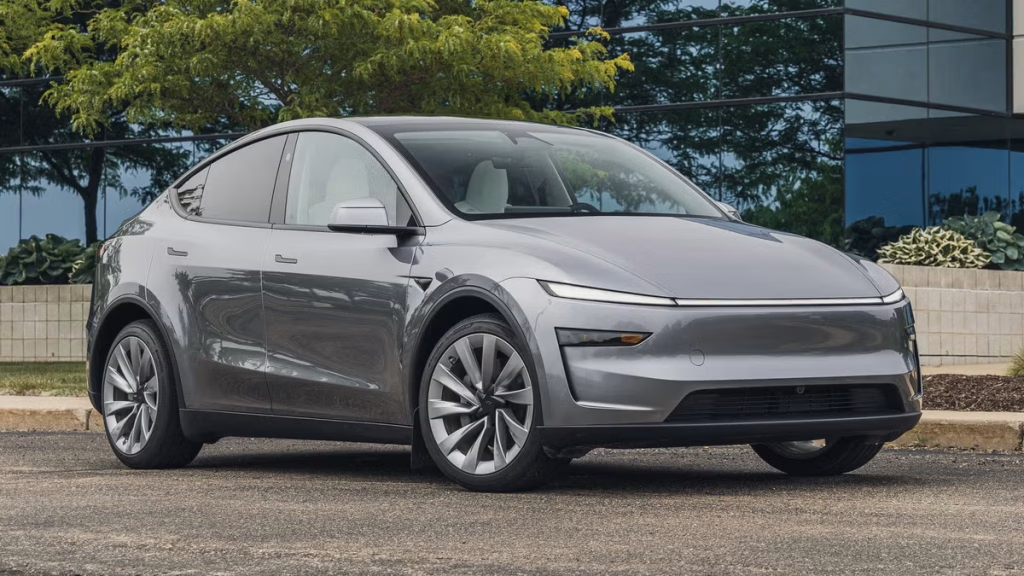
On the model side, the Tesla Model Y in its refreshed “Juniper” form remains the best-selling electric car on Earth, starting around $43,990 with roughly 320 miles of range. The BYD Seagull, sold as the Dolphin Surf in some markets, is a tiny, cheap runabout that became BYD’s own top seller, proof that affordable EVs are where the real volume lives.
The Volkswagen ID.4 took the top BEV spot in several European markets in 2025, and the Hyundai IONIQ 5 picked up Kelley Blue Book’s 2026 Best Overall EV award after Hyundai dropped its starting price to around $35,000.

The pattern across all of them: the winners aren’t chasing luxury flex anymore, they’re chasing range, price, and everyday usability.

The Tech That’s About to Change Everything
Solid-state batteries are finally graduating from lab demos to production plans. Toyota has targeted mass production for 2027 or 2028, promising roughly double the range and dramatically faster charging than today’s lithium-ion packs, though the tech will likely debut in premium vehicles first.
Sodium-ion batteries are arriving even sooner. CATL is rolling sodium-ion packs into passenger EVs by the end of 2026, and one of the biggest wins isn’t just cost, it’s cold weather performance: some packs retain 90 percent of usable capacity even at negative 40 degrees.

Charging speed is entering genuinely sci-fi territory. CATL’s newest Shenxing battery can go from 10 to 98 percent charge in about six and a half minutes. Pair that with 800-volt architecture spreading from premium sedans into everyday crossovers, and range anxiety starts to look like a 2020s problem rather than a permanent one.
Vehicle-to-grid tech is the sleeper hit of the bunch. GM recently activated 250,000 existing bidirectional-capable vehicles as a virtual power plant, entirely through software, no new hardware required. A parked EV quietly becomes a battery for the house or the neighborhood.

Where the Next Five Years Head
Stack it all together and the next five years look less like a gradual ramp and more like a compounding curve. Volume keeps climbing hard, likely well past 30 million annual EV sales globally before the end of the decade, with China holding its lead but Europe, Southeast Asia, and Latin America closing in as battery costs keep dropping.
Affordability becomes the real battleground. The BYD Seagull and Hyundai’s price cuts on the IONIQ 5 are early signals: the brand that wins the 2030s won’t be the one with the flashiest range number, it’ll be the one that gets a genuinely good EV under $30,000.

Charging stops being the bottleneck, between six-minute fast charging and 800V platforms going mainstream. And the car itself starts doing more than driving, with bidirectional charging turning EVs into home backup power, battery chemistry diversifying across lithium-ion, sodium-ion, and eventually solid-state, and autonomous features creeping from driver assistance toward something closer to real self-driving.

The short version: EVs already won the “will this actually happen” argument. The next five years are about who wins on how good, how cheap, and how smart, and based on the pace of the last twelve months, that fight is going to move fast.
⚡ What is coming next: See all 127 upcoming electric cars, including the ones sold only in China, Europe and India, in our Definitive Guide to Upcoming Electric Cars.
