
The pitch lands somewhere between absurd and inevitable. Dreame, a Chinese company best known for robot vacuums, has unveiled an electric hypercar with twin solid-fuel rocket boosters bolted to the back.
Zero to 100 km/h in 0.9 seconds. If that holds up, it’s the fastest accelerating road car ever built, by a margin that should make any working engineer reach for a calculator.
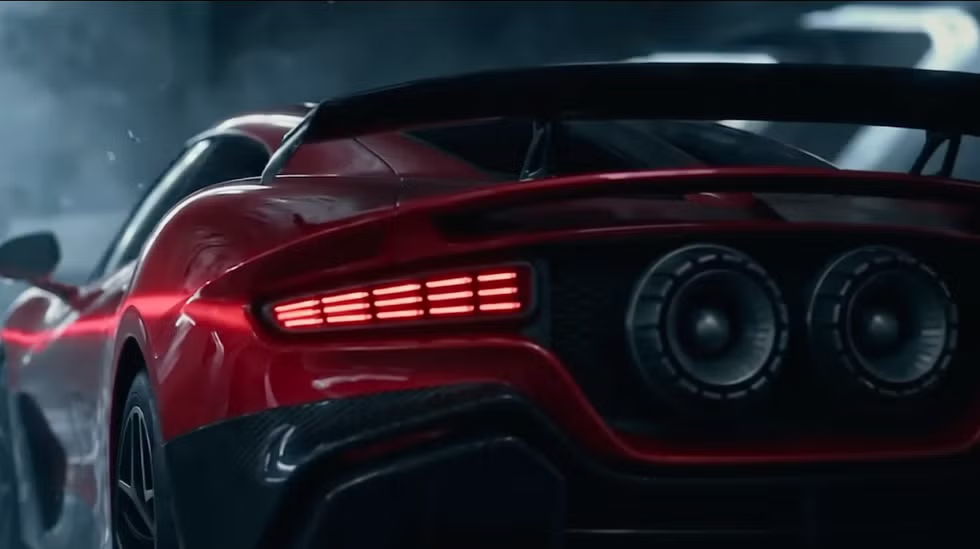
It’s called the Nebula NEXT 01 JET Edition, revealed last week in San Francisco. Sebastian Thrun, the Stanford professor often called the godfather of self-driving cars, was on stage and called it the most exciting product announcement he had ever seen. We’ll let you decide whether that says more about the car or the era.
The numbers, and the small problem with them
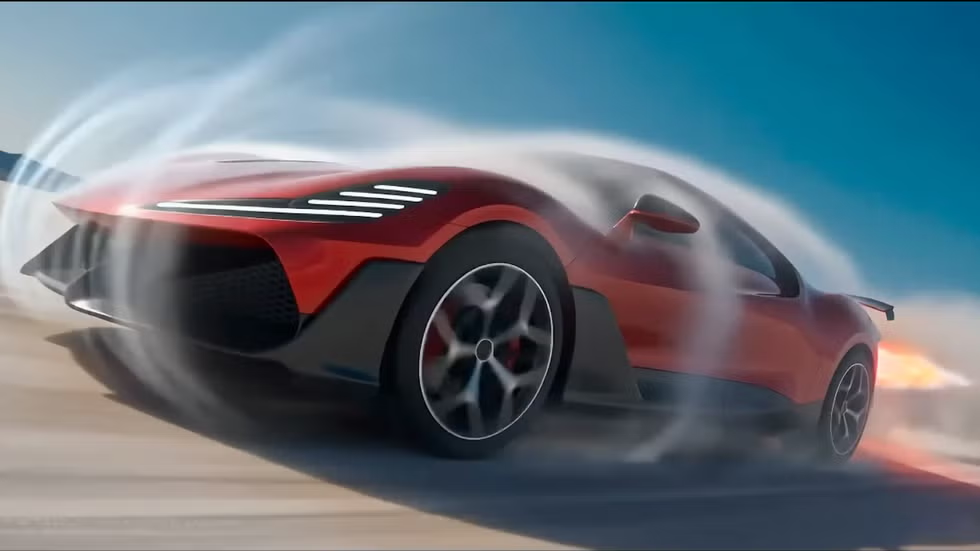
The JET Edition builds on Dreame’s earlier Nebula 1 concept, a 1,876 horsepower electric supercar shown at CES this year. To that already excessive platform, Dreame has added what it calls a custom dual solid-fuel rocket booster system, firing in 150 milliseconds and producing 100 kilonewtons of thrust. Roughly 22,500 pounds of force. From rockets. On a road car.

Here is the catch. A sub-one-second 0 to 60 isn’t a power problem, it’s a tire problem. Today’s fastest EV hypercars are already traction limited, meaning the rubber simply cannot transmit any more force without slipping. The current verified record holder is a 300-pound student-built racer from Stuttgart, with no roof, no doors, and nothing else you’d want in a daily driver. It managed 0.956 seconds. Dreame is claiming a fully kitted hypercar with air suspension, steer-by-wire, and a LiDAR stack will beat that.
Unless the rocket is doing what tires can’t. Which is, in fact, the entire point of a rocket. It’s also the entire point of why this is a wild proposition rather than a refined one.
We’ve heard this song before
If this rings a faint bell, it should. In 2017, Tesla announced a second-generation Roadster with an optional SpaceX package promising cold-air thrusters and similar acceleration claims. Nine years later, that car still does not exist. A vacuum company from Suzhou has, for now, beaten Elon to the demo floor.
Dreame’s path here is less random than the vacuum framing suggests. Founder Yu Hao came out of Tsinghua’s autonomous driving program, and the company has spent over a decade building high-speed digital motors that spin to 200,000 RPM. That kind of motor work translates surprisingly well to electric powertrains. Dreame also debuted a new LiDAR unit, the DHX1, claiming a leap from point-cloud perception to image-level resolution sharp enough to spot potholes and pedestrian micro-movements at distance.
What to actually believe
The promo video carries a quietly telling disclaimer: the JET Edition is “not yet available for sale” and the “final production version is subject to the actual product.” Translation: this is a concept, possibly a sales pitch for the underlying tech stack, possibly a brand statement. Probably some of each.
That said, the Chinese EV industry has earned the benefit of the doubt. Xiaomi went from zero to a credible performance EV faster than legacy automakers iterate a single trim level. BYD eclipsed Tesla in global sales. Companies nobody had heard of five years ago are now setting Nürburgring records. Writing off Dreame because it makes vacuums would echo the same instinct that dismissed Xiaomi a few years back.
The Nebula NEXT 01 JET Edition is best read as a flare gun fired into the EV sky, signaling that this next phase is going to get very strange, very fast. We’ll be watching for an independent timing run, a homologated production version, and a price tag attached to anything resembling a real car. In the meantime, it’s worth remembering that the most interesting EVs of the next decade are unlikely to come from the companies we currently expect.
Even the ones that, until very recently, were mostly cleaning our floors.

One thought on “A Robot Vacuum Company Wants to Strap Rockets to an EV”